
Your Same-Day Cutoff Has Passed. Your Customers Are Still Shopping.
What October shopping patterns from analyzing flower shops reveal about when customers arrive.
By Daniela Marquez
Imagine it’s 2:15 p.m. Someone is running late, trying to get flowers to their mom for her birthday. They still want her to open the door today and know they remembered.
Tomorrow’s flowers would be a different gesture.
Your same-day cutoff was 2 p.m.Inside the shop, that cutoff has a job. Arrangements need finishing, deliveries need organizing, and earlier promises need keeping. But a florist who can still make that delivery has something valuable to offer: a way for this person to come through.Another 30 minutes of same-day availability could be the difference between “I wish I could help” and “We can get them there.” The shop earns an order by making something important possible.
Same-day delivery is a substantial part of this business. In our October study of 480 U.S. flower shops, nearly 4 in 10 recorded delivery orders were placed for delivery that day.And customers were still arriving in the afternoon. From 2 to 3 p.m., the average hourly shopping pattern across these shops showed 88% as much activity as the busiest hour of the day.Behind some of those visits may be someone whose chance to send flowers today depends on finding a shop that can still say yes. If your shop can reliably prepare and deliver a little later, that is the opportunity worth examining.
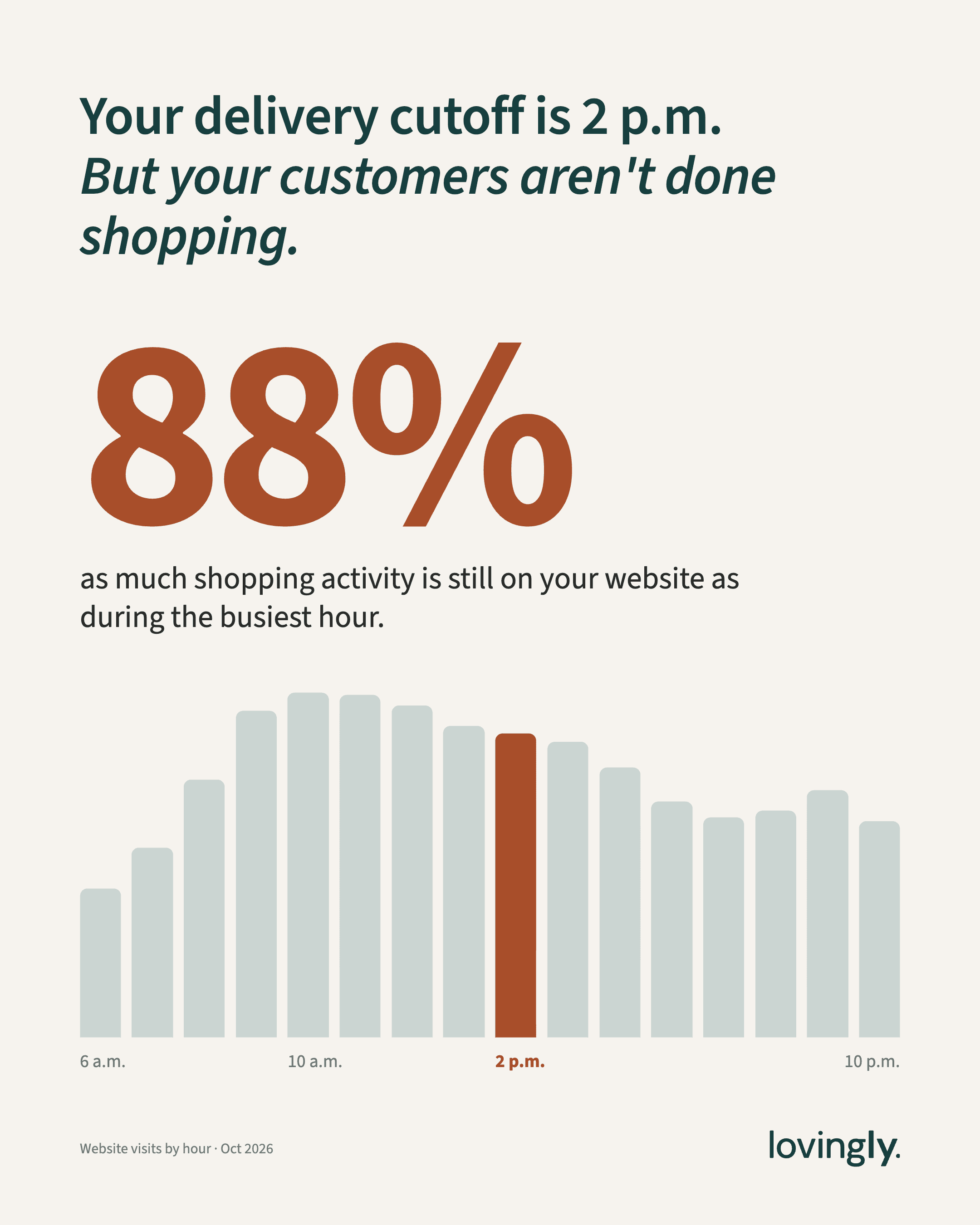
The afternoon stays busy
In the average shopping pattern, the busiest hour was 10-11 a.m. Activity stayed high after that. Noon-1 p.m. reached 96% of that peak, and 2-3 p.m. was still at 88%.
That changes how a 2 p.m. cutoff looks: it lands in the middle of an active afternoon, not at the end of the shopping day.
We gave every shop equal weight so the largest websites wouldn’t set the whole picture. We also split shops into smaller-, middle- and larger-volume groups. In all three groups, 2-3 p.m. kept roughly 86-89% of the activity of that group’s busiest hour. The smaller-volume group had fewer visits to work with, but the afternoon pattern held across all three groups.
One note on what 88% means: it compares one hour with another. It does not mean 88% of visitors want same-day delivery. It shows that a cutoff can fall inside a busy shopping window.
Your order list tells only part of the story
Visits and orders show different things, which is why it helps to look at both.
Across the shops we studied, website visits fell by just 3% from 1-2 p.m. to 2-3 p.m. Over the same hours, recorded same-day delivery orders dropped from 462 to 167. Orders for future delivery dates held nearly steady, at 749 and 759.
People kept visiting. What changed was the mix of delivery dates.
It’s tempting to read that as proof that cutoffs cost shops orders. The data can’t tell us that. We couldn’t confirm each shop’s cutoff during the study, and the orders don’t reveal what every visitor originally wanted. Some customers may have been planning ahead. Others may have settled for a later date. We can’t count how many wanted today and left without ordering.
For an owner, the useful distinction is this: a quiet same-day order queue doesn’t necessarily mean a quiet website.
Your order list shows the purchases that happened. It can’t show the requests your website couldn’t meet. Knowing when people arrive gives you more of the picture when you review your cutoff.
What an extra half-hour covers
Here’s a simple illustration. Picture a shop with 1,000 website visits in a month, following the average timing pattern from this study.
About 28 of those visits would start between 2 and 2:30 p.m. About 56 would start between 2 and 3 p.m., including that first half-hour.
A later cutoff wouldn’t create those visits, and not every visit would become an order. What it changes is the same-day option those visitors find when they arrive.
The second half-hour matters too. Activity from 2:30-3 p.m. was nearly as high as from 2-2:30 p.m., so customers kept arriving through the whole hour.
That gives you something concrete to weigh. If another 30 minutes fits comfortably into your day, there’s real shopping activity in that window. If a full hour is feasible, the next half-hour has activity too. How much of it you can serve depends on what those customers need and what you can fulfill.
Start with the delivery promise
Picture two shops weighing the same change.
At the first, the final delivery route leaves with enough lead time to prepare one more arrangement. The flowers and design capacity are available. Moving the cutoff by half an hour could let one more order join a route that’s already going out.
At the second, the driver has already left and the designers are committed to tomorrow’s event. Taking that same order would mean finding another way to deliver it, interrupting planned work or asking someone to stay late.
The customer’s need is the same. The shops’ ability to meet it is not.
A later cutoff makes sense when your shop can keep the promise behind it. Prep time, stock, delivery distance and the remaining route all belong in that decision, along with room for the unexpected. Every new order has to be worth the work it adds.
Before you change the setting, trace one late order through your shop. Who would make it? When would it leave? Could it reach the recipient as promised?
You may find room on some days and very little on others. You may also find that your current cutoff is exactly right. The point of the data is to make that call with your customers’ shopping hours in view.
Back to 2:15
That customer is still hoping their mom can receive flowers on her birthday. They’re looking for a florist who can make that happen.If your shop can make room, you could be the florist who helps them come through. You earn the order, and their mom gets the flowers today. That is the possibility behind another half-hour of same-day availability.
Open your website and check your same-day cutoff. Then look around your shop and ask: Could we still help someone send flowers today, a little later than our cutoff allows?
About the data
Lovingly analyzed tracked website visit starts and recorded web orders for a sampling of eligible U.S. flower shops from October 1-30, 2026, using each shop’s local time. The hourly profile gives each shop equal weight by averaging the share of its full-day visits that occurred in each hour. The 3% adjacent-hour comparison uses total visits across the sample. Visits are not unique people, and orders were not linked to individual visits. Recorded fulfillment dates may have changed. This one-month snapshot does not measure unmet same-day demand, additional sales or profit from a cutoff change. Two p.m. is an illustrative cutoff, not an industry-wide standard. The customers and shops described in this article are imagined examples.
Make more time for your flower shop
See how Lovingly helps florists spend less time on busywork.
Explore Lovingly for floristsKeep useful flower-shop ideas coming
LUMA Letters is Lovingly's practical newsletter, with tips you can put to work in your flower shop.