
How to reply to Google reviews for your flower shop
A practical guide to replying to praise, mixed reviews, and complaints about your flower shop, with examples you can adapt to your own customers.
By Daniela Marquez
Picture four reviews waiting in your shop's Google Business Profile.
One five-star review says only “Flowers were nice, thanks.” Another praises a bright graduation bouquet and the help at the counter. A third says the flowers were beautiful but arrived after a retirement lunch. The last says the arrangement delivered did not look like the website photo.
These reviews call for different replies. Their tone, level of detail, seriousness, and the facts your shop can confirm all matter more than the star rating alone.
The simplest way to respond is to read for the customer's real point, check what happened, acknowledge that point in public, and handle private details privately. A good reply sounds like your shop paid attention. It also gives the next person reading your reviews a clearer picture of how you treat people.
Here is a way to make that decision without writing a new speech every time.
Before you type, sort the review
Start with the words, not just the stars. Ask:
- Is this brief praise, detailed praise, a mixed experience, or a complaint? Use a detail the customer shared when there is one. Do not make one up when there is not.
- How serious is the concern? A preference about color needs a different first move from flowers that arrived after the event. A review alleging harm needs a responsible person to investigate.
- What can you confirm? Check the order, delivery notes, messages, and your team before stating what happened. A public reply is a poor place to guess.
- What belongs in public? Thank the customer or acknowledge the concern there. Keep order numbers, addresses, recipient details, payment information, and the back-and-forth of resolving an issue in a private conversation. If you can identify and reach the customer, contact them yourself. Ask them to contact the shop when you cannot reach them directly.
You can use this short pattern for most replies: notice the specific point, respond to it plainly, and offer a real next step if one is needed. The examples below show how that pattern changes with the kind of review.
1. Positive reviews: match the detail they give you
A five-star rating can come with a few words or a full story. The short one does not need a clever reply. The detailed one gives you a chance to show you heard what made the flowers matter.
When the review gives you almost nothing
Fictional review and reply
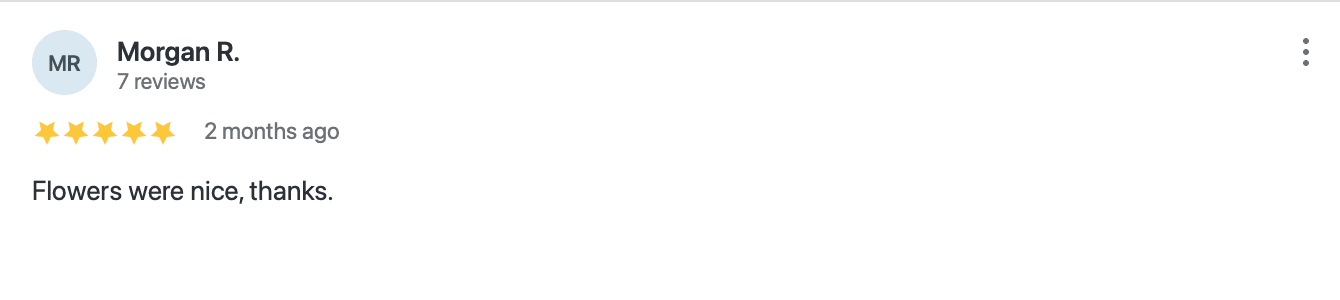
Shop reply: “We're glad you liked them. Thank you for taking a moment to tell us.”
Why this fits: The shop answers the customer's brief praise without inventing who ordered the flowers or why. A short review does not need a made-up detail to earn a human reply.
When the customer tells you what they loved
Look for one detail the customer chose to share. It may be a color request, an occasion, or the care someone took at the counter. You do not need to repeat every detail or reveal anything the customer left out.
Fictional review and reply
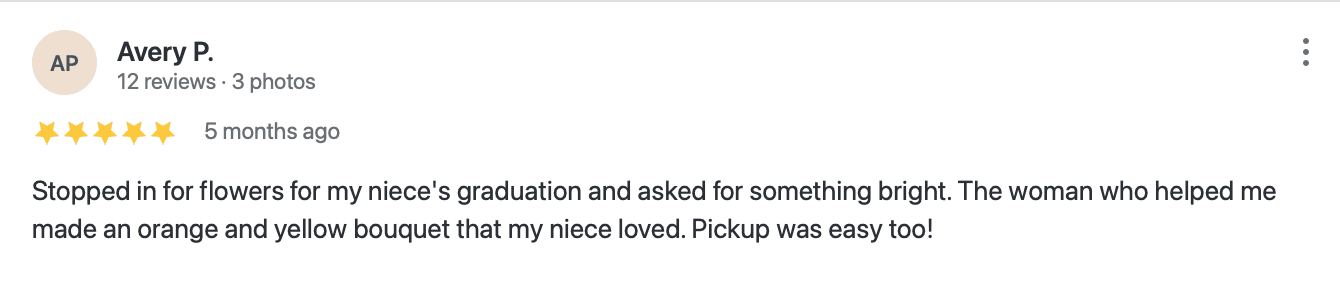
Shop reply: “We're so glad the bright bouquet felt right for the graduation, and that pickup was easy. It was a pleasure helping you choose flowers for the celebration.”
Why this fits: The reply picks up the occasion and the help choosing without turning a thank-you into an ad. A future shopper can see that the shop listened to what this customer wanted. It does not need to match every exclamation mark or mention the recipient by name.
2. A mixed review: acknowledge the praise and the miss
Some reviews begin with praise and then name a problem. Do not let the compliment make you miss the concern. Flowers that look beautiful can still arrive too late for the moment they were meant to mark.
In this fictional example, the shop checked its records, confirmed that the flowers arrived a day after the chosen delivery date, and can reach the customer privately.
Fictional review and reply
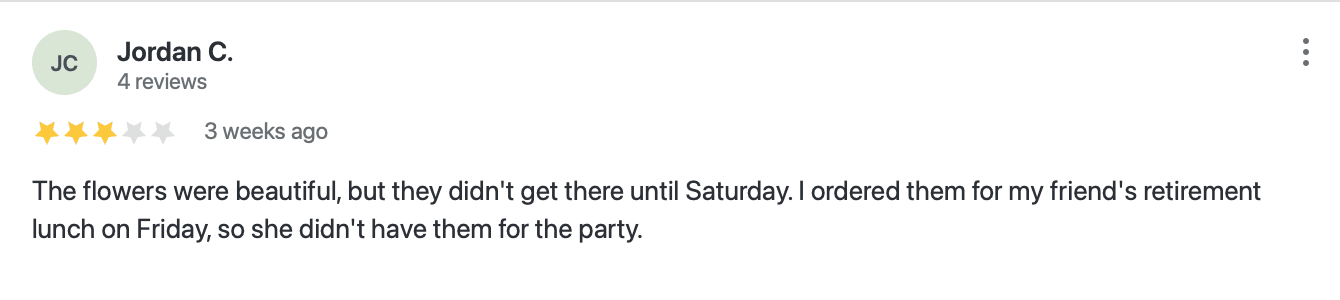
Shop reply: “I'm glad you liked the bouquet, and I'm sorry we missed the delivery date you chose. The timing was part of the gift. We'll contact you privately to discuss the order and the next step.”
Why this fits: The shop hears the praise without using it to soften the real complaint. It takes responsibility for the delivery fact it checked and recognizes that the occasion cannot be replayed. Because the shop can reach the customer, it takes on the follow-up rather than making the customer start it. The team must then do what the public reply promised. A public reply is the beginning of a response, not the resolution itself.
If you have not confirmed the delivery facts, use different wording: “I'm sorry the flowers did not arrive when you expected. We'll check the delivery details and contact you privately.” Use that version only if you can identify and reach the customer. If you cannot, ask them to contact the shop so you can look into it. Do not use uncertainty to avoid responsibility once you know what happened.
3. An unhappy review: address the gap without getting defensive
An ordinary unhappy review may be direct and specific, without praise or a serious allegation. An arrangement that looks different from the website photo is worth checking. Do not assume the customer misunderstood the photo or that a substitution explains everything. Compare the product description, the order, and what the shop delivered before explaining the difference. In this fictional example, the shop matched the reviewer to the order and can reach them, but has not checked why the arrangement looks different.
Fictional review and reply
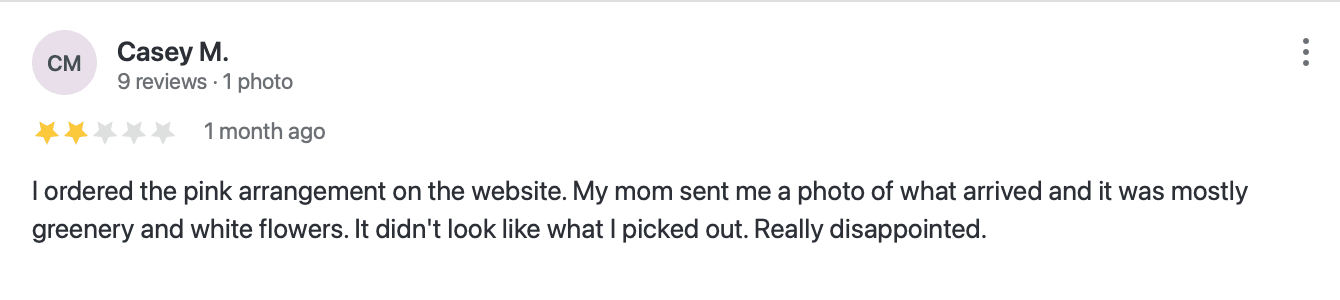
Shop reply: “I'm sorry the flowers delivered didn't look like the photo you chose. We'll contact you privately to compare the order and the delivered arrangement, then discuss what to do next.”
Why this fits: The reply names the actual complaint without debating the colors in public or claiming a cause before the shop checks. Because the shop can reach the customer, it takes the next step itself. If your team confirms a mistake and agrees on a remedy, say what you will actually do. Do not make a public promise the shop has not approved, and follow through on the contact you promised.
A low rating with no written explanation gives you even less to work with. Do not guess in public whether the issue was the flowers, delivery, or service. If you can confidently match the rating to a customer and have a way to reach them, ask privately what happened; otherwise, a brief public invitation to contact the shop is enough.
4. A serious pet-health concern: respond to urgency, not a diagnosis
An allegation that a pet may have become ill after getting into a bouquet needs a different process from a picture mismatch. Do not decide in a public thread whether the flowers caused the illness. Alert the owner or the person responsible for handling serious complaints, preserve the review and relevant shop records, and identify the arrangement if you can. If you know how to reach the customer, do so privately. Do not ask them to publish order or health details.
If a pet may have chewed or eaten part of the bouquet, point the customer promptly to a veterinarian or animal poison specialist. The ASPCA advises contacting a veterinarian or ASPCA Animal Poison Control when ingestion of something toxic is suspected. A review reply is not a place to diagnose the pet or identify a plant from a description.
In this fictional example, the shop cannot identify the customer from the public review, so a short reply asks them to make private contact while pointing to professional help.
Fictional review and reply
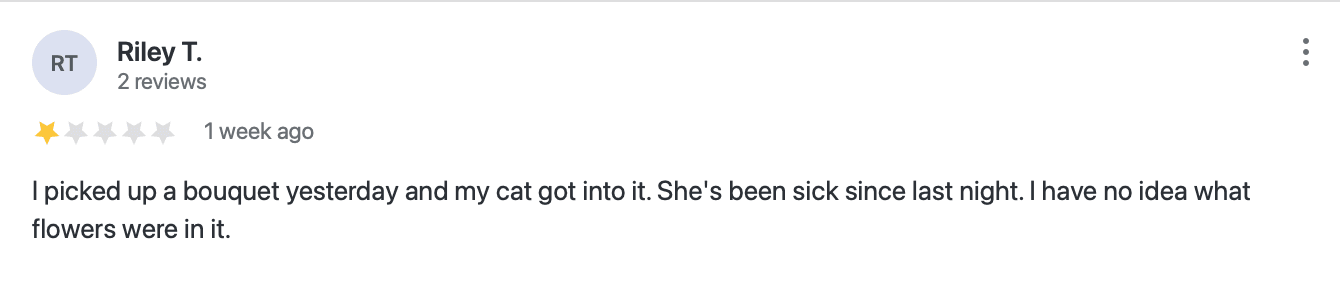
Shop reply: “We're concerned to hear about your cat. If your cat may have chewed the flowers, please contact your veterinarian or ASPCA Animal Poison Control right away. Please contact our shop privately so we can identify the bouquet and review what happened.”
Why this fits: The shop treats possible exposure as urgent without claiming the bouquet caused the illness or offering medical advice. It moves the arrangement details into a private conversation. If the shop has already reached the customer, the public reply should say only what it actually did, rather than asking them to repeat the details.
A privacy allegation calls for the same restraint. If a reviewer says a delivery label exposed personal information, do not repeat the address or order details in your reply. Preserve the records, contact the customer privately when possible, and have the responsible person investigate. Do not claim that an investigation is underway until it is.
If you cannot match a review to an order
A name that does not appear in your order history does not prove the review is false. The sender, recipient, and reviewer may be different people. The customer may have used a nickname or ordered through another channel. A review may also be for another shop. Check what you reasonably can without posting anyone's order information.
If you still cannot identify the experience, a brief public response can invite a private conversation: “We'd like to understand what happened, but we can't identify the visit from the details here. Please contact our shop directly so we can look into it.” Do not accuse the reviewer of lying or name a competitor.
If a review appears to break Google's rules, use Google's reporting process. Google says only reviews that violate its policies are eligible for removal. Disagreeing with a negative review is not a reason by itself. Keep a record of what you checked so the next person on your team understands the situation.
What to leave out of every reply
Before posting, read your draft once more as if the customer and a new shopper will both see it. Remove:
- Private details: order numbers, addresses, phone numbers, payment details, and information about the recipient.
- A debate: point-by-point arguments about what the customer “should” have done.
- An unapproved promise: a refund, replacement, or deadline your shop has not agreed to meet.
- A bargain for a better rating: do not offer a gift or discount in exchange for changing or removing a review. Google's guidance also tells businesses not to offer incentives for review changes or removal.
- A stock closing line that ignores the review: if the customer mentioned a late delivery or a picture mismatch, answer that point before inviting them back.
Google recommends keeping replies short, conversational, and specific. You can be all three while sounding like your own shop. A florist with a warm, familiar voice and one with a quiet, formal voice do not need identical wording. Both need to be accurate.
Try it with one review from your shop
Pick one review you have not answered yet. Write down the customer's main point in a few words. Check any facts your reply depends on. Then draft two or three sentences: acknowledge that point, use a detail you can truthfully speak to if the review gives you one, and offer a private next step only if the situation needs one.
Read it once more before you post. Does it answer this customer? Does it keep private information private? Can your shop follow through on what it says? If yes, you have a reply that fits the review in front of you.
Make more time for your flower shop
See how Lovingly helps florists spend less time on busywork.
Explore Lovingly for florists